
Task Suite 3: Brain Region Prediction#
TS3 evaluates neuron-level representations by predicting the Cosmos-level anatomical region (10 classes, Allen CCF) of individual units. Regions span coarse but functionally meaningful areas such as Isocortex, Hippocampus, and Cerebellum. Both single-unit and multi-unit settings are covered.
All evaluations are zero-shot on held-out animals. Two regimes are included: transductive zero-shot (adaptation via non-region supervision is allowed) and inductive zero-shot (no adaptation). Performance is reported as macro-averaged F1 to account for class imbalance.
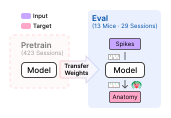
Overview of TS3#
Note
“Probe” carries two meanings in this guide. A recording probe is the Neuropixels
insertion a unit sits on: what probe_qc filters and what the multi-unit readout
pools within. A probe on its own, as in probe=linear, is the classifier
ts3/eval.py fits on frozen embeddings to predict the brain region.
Every unit is assigned one of ten Cosmos-level regions, and a submission is scored twice:
Setting |
What is scored |
Primary metric |
|---|---|---|
Single-unit |
the probabilities a model gives each unit on its own |
Macro F1 |
Multi-unit |
the same probabilities averaged over a unit’s five nearest neighbours on the same recording probe within 60 µm, itself included |
Macro F1 |
The ten classes are CB, CNU, CTXsp, HB, HPF, HY, Isocortex,
MB, OLF and TH. They are imbalanced, which is why the metric is
macro-averaged rather than a plain accuracy.
Evaluation pipeline#
The probe is fit on the pretrain units and their region labels, and scored on the eval units, which come from animals held out of pretraining. The eval labels are only ever scored against, never fit to.
Which regime a model belongs to is a property of the model, not a setting you pick:
Inductive. The unit’s embedding is a function of the unit’s own data, so one encoder answers for pretrain and eval units alike. NuCLR, NEMO and the ISI baseline.
Transductive. The embedding is a free parameter that exists only for units a run has seen, so the eval units are answered by per-session checkpoints adapted on non-region supervision. NDT Stitch and POYO.
Two layers of unit QC#
Unit QC is applied at two independent points, and the two do not enforce the same rule. A unit count that looks wrong is usually the two being read as one.
Build time bakes the three filters from Why two builds into the
.h5. It defines the stored population, and it is what unit_filtering records.
Load time is applied by the consuming task suite on top of whatever the build contains. It is task specific and is never recorded in the file.
Mostly, load time just re-verifies the build. These three criteria are checked at both layers with identical thresholds, so they never change the population:
Criterion |
Build time |
Re-applied by TS3 scoring |
|---|---|---|
|
|
|
|
|
|
|
|
|
Only three criteria are genuinely load time. No build applies them, so no
--unit-filter value can satisfy them:
Criterion |
Rule |
Applied by |
|---|---|---|
|
|
the TS3 dataset mask and scoring, identically |
|
|
TS3 scoring |
Brain region |
not |
TS3 scoring |
Two consequences are worth stating plainly:
Because
probe_qcis not applied to pretrain sessions, a pretrain build labeledselected_unitsstill contains units on recording probes whoseqc_neuralisWARNINGorFAIL. TS3 masks theFAILones at load time and trains on theWARNINGones, which are about 30% of pretrain recording probes. TS3 also drops the 32 pretrain sessions whose every recording probe isFAIL.Because the last two criteria are invisible to the build,
selected_unitsdoes not mean “the population TS3 scores on”; that population is pinned by_EXPECTED_MD_SIZEinsrc/ts3/protocol.py.
How to use the TS3 benchmark#
TS3 scores unit embeddings rather than a trainer, so what you supply depends on the shape of your model. There are two ways to plug in:
Supply an Extractor: turn your model into one embedding per unit, let
ts3/extract.pywrite them andts3/eval.pyfit and score the probe. This is the path for anything pretrained.Bring your own trainer: a model supervised on the region labels skips embeddings and the probe entirely, and reports F1 from its own run, as LOLCAT does.
Key classes#
IBLBrainWideBenchTS3: whole sessions after the suite’s unit QC, which is fixed rather than a parameter.Extractor: the interface an embedding model implements, and whatextract.pydrives.TransductiveExtractor: base for extractors whose embeddings exist only for units a run has seen.Probe, withLinearProbeandMLPProbe: the headseval.pyfits on frozen embeddings.LOLCATTrainer: the worked example of a model that skips the probe and scores from its own run.
Model families#
NuCLR and NEMO pretrain from src/pretrain/train.py, alongside the TS1 and
TS2 pretraining models; LOLCAT and the ISI baseline stay in src/ts3. Turning any
of them into unit embeddings is one step, src/ts3/extract.py, and which extractor
it runs is grouped by regime under src/ts3/models/: inductive/ for the models
whose unit embedding is a function of the unit’s own data, transductive/ for those
whose unit embedding is a free parameter that exists only for units a run has seen.
NuCLR learns a shared embedding space from unit features using contrastive
learning. Pretraining is handled by NuCLRPretrain; the
loss is NuCLRLoss.
NEMO fuses waveform and autocorrelogram modalities via a CLIP-style objective.
WVFEncoder and ACGEncoder
produce per-modality embeddings that are aligned by core.nn.loss.CLIPLoss
through a LinearProjector.
LOLCAT is supervised rather than pretrained. An MLP embeds each of a unit’s
per-trial ISI histograms, MultiHeadGlobalAttention pools the trials
into one unit-level vector, and a linear head predicts the region, so it reports
F1 directly instead of going through a probe.
LossFeedbackSampler retunes the per-class oversampling factors
between epochs from the train/val loss gap.
ISI histograms is a training-free baseline. extractor=isi writes one
log-spaced, L1-normalised compute_isi_histogram() per unit and uses it
directly as the embedding.
How do I evaluate my model on TS3?#
Extractor interface#
The sampled-window flow of How a sample reaches the model does not apply here. extract.py
builds one extractor and asks it for the pretrain units, then the eval units. The two halves
of the file are comparable only because the same object answered both calls, so the regime is
an argument rather than a field:
from core.dataset import BenchmarkRegime
from ts3 import Extractor

class MyExtractor(Extractor):
    @property
    def name(self) -> str:
        """Names the embeddings file, so two runs do not overwrite each other."""

    @property
    def run_seed(self) -> int | None:
        """The seed behind these embeddings, which a submission is filed under."""

    def encode(self, regime: BenchmarkRegime):
        """Return (N, D) embeddings and the (N,) uids they belong to."""
setup binds the run’s data root, device and logger, and is where a checkpoint is loaded
once rather than per regime. Units your extractor cannot represent may be left out: the
probe joins on uids and drops anything TS3 does not score, but insists the eval side is
complete.
Which checkpoint answers the eval call is the entire inductive/transductive difference, and
it is settled inside encode, not by the caller.
Writing embeddings#
extract.py writes one .pt per run into embs_dir, named after the extractor
unless name= overrides it. The file holds both regimes’ embeddings with their uids, and
the run_seed the extractor reported. Naming by run keeps several epochs of one model, or
several finetuning seeds, from overwriting each other.
Probing#
After pretraining, a probe is fit on top of frozen embeddings by
ts3/eval.py with probe=linear or probe=mlp, and scored with macro-averaged
F1. LOLCAT skips this step. NuCLR and Nemo also probe themselves while pretraining, but
that monitor belongs to each of them (pretrain/models/*/monitor.py) and reads
pretrain units only, so it never touches the units scored here.
The released NuCLR and NEMO repositories ship the unit embeddings each of their
checkpoints produced, as <model>_embeddings_<seed>.pt, so
ts3/eval.py emb_path=<FILE> probes them directly and extract.py need not run
again. Released checkpoints covers the download.
Bringing your own trainer#
A model supervised on the region labels has no embedding step and no probe. It trains and
scores in one call through src/ts3/train.py, reports macro F1 directly, and writes its
own submission. LOLCATTrainer is the worked example, and a
trainer of your own owes what pretraining describes.
What is fixed#
Warning
src/ts3/protocol.py holds the unit table every TS3 metric is computed against, and
_EXPECTED_MD_SIZE pins its size: 3,222 eval units and 41,834 pretrain units for
unit_cosmos. ts3/eval.py is the only scoring path, fitting the probe on pretrain
labels and scoring eval ones, and both regimes must come from the selected_units
build. None of that is yours to change. The extractor, the embeddings it writes and which
probe scores them are.
Launching training and evaluation#
TS3 scores a probe on frozen unit embeddings, so most baselines are two calls, both driven
by Hydra: write the embeddings with src/ts3/extract.py, then fit
and score the probe with src/ts3/eval.py.
An inductive extractor reads one pretrain checkpoint (Released checkpoints) and encodes the pretrain and eval units with it:
python src/ts3/extract.py extractor=nuclr data_root=<data_root> extractor.ckpt=/path/to/ckpt.pt
extractor=isi is training free and takes no checkpoint at all.
A transductive extractor requires three calls rather than two, because it also needs a
calibration checkpoint for every eval recording. Calibration continues the model’s own
pretraining objective on one eval recording, initialized from the shared pretrain
checkpoint, and writes a session-local best.pt whose unit table or stitcher becomes
the eval part of the embeddings file.
Run one calibration per (recording, seed), into a directory used by that sweep and
nothing else. src/ts3/scripts/calibrate.py does the whole grid as one Ray sweep,
every eval recording by every seed:
python src/ts3/scripts/calibrate.py trainer=poyo_plus_calibrate \
    ckpt.load_from=/path/to/pretrain.pt ckpt.dir=/path/to/calibrations \
    +ray.gpu=0.125 +ray.cpu=3
src/ts3/train.py runs a single one instead, for a single recording:
python src/ts3/train.py trainer=poyo_plus_calibrate \
    ckpt.load_from=/path/to/pretrain.pt ckpt.dir=/path/to/calibrations \
    recording_ids=[<eid>]
Extraction then reads the pretrain checkpoint for the pretrain part and scans
extractor.ckpt_dir for the eval part, keeping every best.pt whose saved config
names one recording, that seed, and the same model:
python src/ts3/extract.py extractor=poyo_plus \
    extractor.pretrain_ckpt=/path/to/pretrain.pt extractor.seed=<seed> \
    extractor.ckpt_dir=/path/to/calibrations
Warning
extractor.ckpt_dir scans the ckpt tree recursively. The scan keeps any best.pt whose
config names one recording, a seed, and the same model. Pointing extraction at a shared root
therefore picks up runs you did not mean. Two matches for one (seed, recording) raises an error,
and a missing one fails the scan.
Therefore, ckpt_dir is mandatory (no defualt), and calibration for a given model
should be given a fresh directory. For example:
$BWB_CKPT_DIR/ts3-calibrations/poyo_plus/
Pass that one path as ckpt.dir when calibrating and as extractor.ckpt_dir when
extracting. filters narrows the scan on any config field if checkpoints must share
a directory.
The other transductive models follow the same three-step pattern: swap poyo_plus for
possm, ndt_stitch, or mtm in every command.
Either way the embeddings land in embs_dir (BWB_EMBS_DIR, default embs/). Pass
that file to the probe, which reports macro F1 single-unit and multi-unit:
python src/ts3/eval.py probe=linear data_root=<data_root> emb_path=/path/to/embeddings.pt
The linear probe is CPU; probe=mlp searches probe.num_trials configurations on a GPU
instead. LOLCAT is supervised on the region labels and has no embedding step, so it trains and runs
the test protocol in one call, like a TS1 or TS2 baseline:
python src/ts3/train.py trainer=lolcat data_root=<data_root>
save_preds writes the prediction file the leaderboard scores. For an embedding
model it comes from the probe:
python src/ts3/eval.py probe=linear emb_path=/path/to/embeddings.pt \
    save_preds.enable=true save_preds.label=<submission-id>
The submission is filed under the seed extract.py recorded in the file; add seed=
only for an embeddings file you built yourself, which records none. LOLCAT writes from its
own run instead, with the same two flags on src/ts3/train.py.
Key config options#
Defaults live in src/ts3/configs/extract.yaml and src/ts3/configs/eval.yaml.
Extraction. name overrides the file name, which otherwise comes from the extractor,
and embs_dir says where it lands (BWB_EMBS_DIR in your .env,
default embs/). A transductive extractor also reads extractor.pretrain_ckpt, the
shared checkpoint behind the pretrain part, extractor.seed, which selects the
calibration run, and extractor.ckpt_dir, the sweep directory scanned for those
calibrations. All three are mandatory: there is no sensible default for which sweep to
read.
Probing. task is unit_cosmos, the only one defined today. probe.num_trials
sets how many configurations probe=mlp searches. seed names the submission rather
than seeding anything, and is needed only for an embeddings file that records none.
Both entry points read data_root from BWB_DATA_ROOT_SELECTED_UNITS: TS3 refuses any
other build.
Reference baselines#
The training runs behind these baselines are accessible on W&B, linked from each row below. TS3 scores a probe rather than the encoder, so a project holds the probe runs behind the reported numbers, not the pretraining they read from.
Inductive#
The unit’s embedding is a function of its own data, so one encoder answers for both
regimes. Run with src/ts3/extract.py, then score with src/ts3/eval.py.
Model |
Config |
Extractor class |
W&B |
|---|---|---|---|
ISI histograms |
|
|

|
|
|
||
|
|
Transductive#
The embedding exists only for units a run has seen, so each also needs the per-session
checkpoints in extractor.ckpt_dir for its seed. Calibration happens first
(Building and Submitting a Model), then extraction reads its checkpoints; each model lists both
stages as separate rows below.
Model |
Stage |
Config |
Class |
W&B |
|---|---|---|---|---|
Calibrate |
|
|
||
Probe |
|
|
||
MtM |
Calibrate |
|
|
|
Probe |
|
|
||
Calibrate |
|
|
||
Probe |
|
|
||
POSSM |
Calibrate |
|
|
|
Probe |
|
|
Supervised#
Trained on the region labels and scored without a probe, in one call to
src/ts3/train.py.
Model |
Config |
Trainer class |
W&B |
|---|---|---|---|
|
|